Range Repair
Wolf Range Troubleshooting: The Order That Actually Resolves It
A Wolf burner that sparks and never lights is rarely the igniter. Check gas, then spark, then the fouled cap shorting the spark somewhere useless — and treat the oven cavity as a separate machine from the cooktop above it.
4 min read Declan Moriarty, Refrigeration technician — sealed systems and airflow · 21 years in the trade
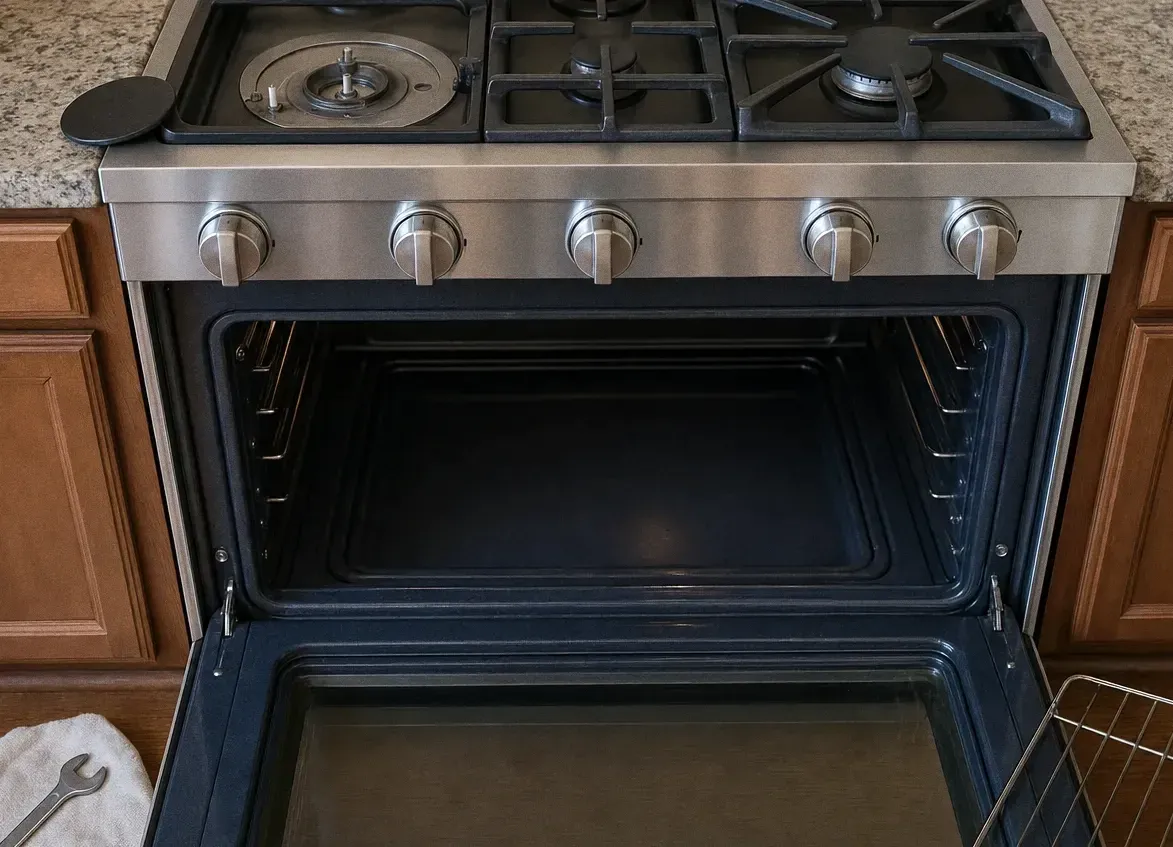
A Wolf range does not usually fail dramatically. What happens is that one burner starts taking three attempts to catch, or the oven begins running slightly cool, or a self-clean cycle finishes and the door stays shut. Each of those has a short list of causes, and the order you work through the list is what decides whether the visit takes twenty minutes or two hours.
The single most useful thing to understand before any of it: the cooktop and the oven cavity are two separate machines that happen to share a cabinet. They have different failure modes, different parts and, on a dual-fuel range, different energy supplies. Diagnosing them together is how people end up replacing the wrong thing.
A burner that sparks and will not catch
This is the most common Wolf call and the most commonly misdiagnosed. The instinct is to blame the igniter, because the igniter is the part making the noise. It is rarely the igniter.
Work in this order:
- Gas first. Is anything else on the range lighting? If nothing is, the problem is upstream of the burner entirely and no amount of work on the cooktop will help.
- Spark second. Watch where the spark actually jumps. It should arc from the electrode to the burner cap. If it is arcing to the pan support, to a spill, or to nothing at all, the electrode has moved or something is in the way.
- The cap third. A cap that has been washed and put back a millimetre out of seat will change where the spark lands and how the gas emerges. Lift it, dry it fully, and reseat it squarely.
Most of the time the answer is at step three. A cap sitting proud, or still damp from cleaning, shorts the spark somewhere useless — and the fix costs nothing but a few minutes.
A burner that lights, then drops out
Different fault, different part. If the flame holds while you push the knob in and dies the moment you let go, the flame-sensing circuit is not confirming that a flame exists. That is a thermocouple or, on newer ranges, a flame sense electrode.
There is one benign version of this worth ruling out first: a burner set so low it is barely alight will sometimes fail to hold on its own. Turn it up, let it settle, then bring it back down. If it holds at a medium setting and only drops at the lowest, the sensing circuit is marginal rather than dead — still a repair, but not an emergency.
The oven running cool
An oven that browns unevenly or takes noticeably longer than it used to is almost never an element. Put an oven thermometer on the middle shelf, set the oven to 350, and let it run for twenty-five minutes before reading it. A gap of fifteen degrees is within normal cycling. A gap of fifty is a sensor reporting the wrong temperature to a control that is doing exactly what it is told.
The distinction matters commercially: a sensor is one of the cheaper parts on the range, and an element is not.
Self-clean, and the door that stays locked
Self-clean is where most Wolf oven calls originate, and the mechanism is worth understanding because it explains why forcing the door is such a bad idea.
The cycle drives a bolt across to lock the door. A switch beside that bolt reports the position the bolt reached. While the instruction and the report disagree, the door stays shut; it opens the moment they match. Two things commonly break that agreement: a thermal fuse that has opened during the cycle, cutting power to the latch motor, and a latch switch that no longer reports its position.
Either way the door is not stuck in the mechanical sense. It is locked, deliberately, by a control that has lost confidence in its own state. Prying at it will break the latch assembly and the door together, and turn a modest repair into an expensive one.
Give it the full cool-down first — four or five hours from the end of the cycle. If it is still locked with the cavity cold, stop there.
A hood that moves air and misses the smoke
Worth including because it arrives as a range complaint and is not one. If your hood runs hard and smoke still escapes at the front, the usual cause is capture area rather than motor power: a hood narrower than the range, or mounted too high, cannot catch what rises outside its footprint.
That is an installation answer, not a repair. Fitting a stronger blower does not widen the canopy, and the smoke escaping at the front is smoke that was never under the canopy to begin with. We would rather tell you that than sell you a blower.
When it is worth calling
Anything involving gas you can smell. Sparking that continues with every control off. A door still locked once the oven is genuinely cold. And the case where you have worked through the burner order above and it still will not light — at that point the remaining candidates are inside the appliance, and they need meter readings rather than guesswork.
Also asked
Every burner clicks when I turn one knob. Are they all broken?
No, and this is the single most misread symptom on a pro range. One spark module drives every electrode on the cooktop, so a fault in that module makes the whole row click together. It is one part. If the clicking continues after every knob is off, switch the range off at the wall and call somebody, because a module that will not stop sparking is not something to live with over a weekend.
Can I keep using the cooktop if the oven has failed?
Usually yes on a dual-fuel range, where the two halves run on different supplies and different controls. On an all-gas range it depends on what failed — a valve or a supply fault affects both. If you can smell gas at any point the answer is no: shut it off at the supply and do not use any of it until it has been looked at.
How long should a self-clean cycle keep the door locked?
Through the cycle and until the cavity has cooled, which together can run four to five hours. Beyond that, with the oven cold and the door still locked, something has failed rather than the cycle taking its time. That is a repair, and forcing the door is what turns a fuse into a fuse plus a latch plus a door.
Related
- Thermador or Wolf: What the Difference Looks Like From Under the Range Both build serious cooking equipment and both are repairable for decades. Where they differ is in what fails, how often, and what it costs to put right — which is a more useful comparison than a specification sheet.
- Ice Maker Not Working: What the Bin Is Telling You Empty bin, hollow shells, cloudy centres or one fused lump — each points somewhere different. Work out which of the four you have before anyone opens the appliance, because the fix for one has nothing to do with the fix for another.
- Wine Storage Temperature: What the Numbers Should Be, and Why Yours Drift A wine cabinet fails quietly. It does not alarm, it does not smell, and a five degree drift can run for weeks before anyone notices — which is why the reading matters more on this appliance than on any other in the kitchen.
If it turns out to be the appliance
The $95 service call covers the visit and the full diagnosis, and it comes off the repair once you approve it. Engineers are out 8:00 am – 8:00 pm, seven days; the line is answered 24/7.