Range Repair
Thermador or Wolf: What the Difference Looks Like From Under the Range
Both build serious cooking equipment and both are repairable for decades. Where they differ is in what fails, how often, and what it costs to put right — which is a more useful comparison than a specification sheet.
3 min read Declan Moriarty, Refrigeration technician — sealed systems and airflow · 21 years in the trade
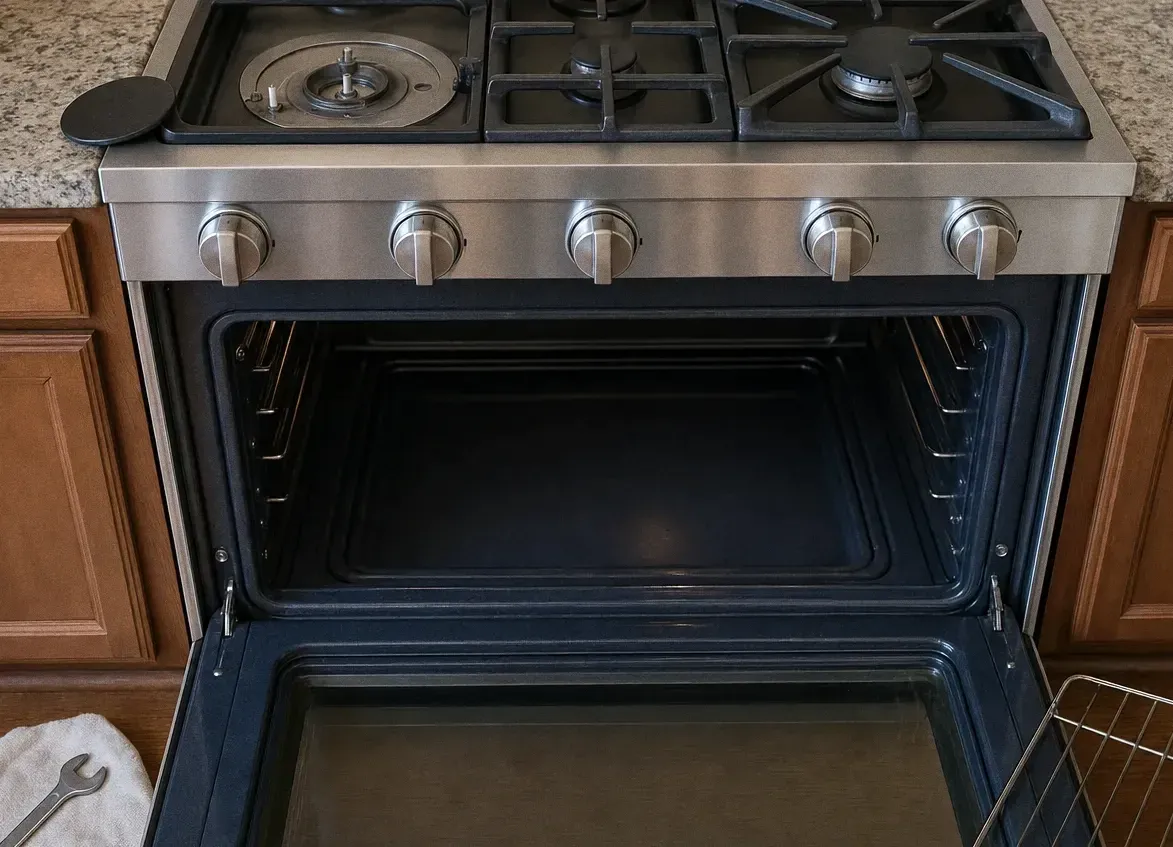
People usually ask this question while standing in a showroom, and the showroom answer is about burner output and styling. That is a reasonable way to choose, but it is not the comparison we can add anything to. What we can describe is what these two brands look like ten and fifteen years in, because that is when we meet them.
Both are good. Neither is a brand we would steer somebody away from. But they age differently, and the differences are specific enough to be worth knowing.
Where Thermador concentrates its faults
Thermador’s cooktops are the reliable half of the range. Star burners are mechanically simple and the ones we see are usually still burning correctly after fifteen years, provided nobody has widened a port with the wrong tool.
The faults cluster in the electronics, and one in particular. A single ignition module drives every electrode on the cooktop. When it fails, every burner clicks whenever any knob is turned — which owners very reasonably report as “all the burners are broken”. It is one part, and it is a straightforward replacement. But it is the Thermador call we take most often.
On the oven and steam side, the pattern is what you would expect from a brand that put electronics where others put mechanisms: level sensors, pumps and control boards rather than linkages. The steam ovens in particular reward a descaling history and punish the absence of one.
Where Wolf concentrates its faults
Wolf’s fault pattern sits on the ignition side and around self-clean. Burners that spark without catching, flames that drop out when the knob is released, and doors that stay locked hours after a self-clean cycle finished.
That last one is the defining Wolf call. It sounds serious and usually is not: a thermal fuse or a latch switch, both modest parts, in a mechanism that has locked the door deliberately rather than jammed it. The damage in those cases is nearly always done by someone forcing the door before anyone looks at it.
The important structural point about Wolf is that the cooktop and the oven cavity are genuinely separate machines. A dead oven does not imply a dead cooktop, and on a dual-fuel range they do not even share an energy supply.
What that means for cost
Neither brand is cheap to buy and neither is expensive to repair, relative to what they cost new. The parts that actually fail on both — igniters, sensors, ignition modules, thermal fuses, latch switches — sit at the affordable end.
The exception on both sides is the control board, and the useful discipline is the same for either brand: boards get blamed first and are the answer last. A board is worth suspecting only after the mechanical and sensing sides have been cleared, and any shop that reaches for one early is guessing with your money.
If you already own one
Then the comparison is academic and the practical advice diverges.
On a Thermador, photograph the panel code before calling anyone. Their diagnostics report more than most, and a code plus a description of what the appliance is actually doing usually narrows a visit before it starts.
On a Wolf, note whether the fault is on the cooking surface or in the cavity, and if it involves self-clean, note how long ago the cycle ended. Those two facts change what gets brought to the door.
If you are choosing between them
Buy on how you cook and how the kitchen looks, because that is what you will live with. Both will still be repairable in twenty years, both have parts available in Greater Boston without the lead times some European brands carry, and neither will surprise you with a failure mode the other avoids.
The one honest tiebreaker: if you want a steam oven in the mix, Thermador has been building them longer and there are more of them in service locally. If you want an all-gas range with the cooking surface as the centrepiece, Wolf’s is the one more Boston kitchens are built around — which matters mainly because it means more shops have seen the inside of one.
Also asked
Which one is more reliable?
Neither, in any way that would help you choose. Both last decades and both develop faults in their second decade. The honest difference is in what those faults are: Thermador concentrates them in ignition modules and electronics, Wolf in ignition components and self-clean hardware. Both are serviceable and neither is a brand we would talk somebody out of.
Are parts easier to get for one than the other?
Both are well supported in Greater Boston and neither has the lead-time problem that the European specialist brands sometimes do. Where a specific part is on back order we say so at the point of quoting, because finding that out after an appliance is in pieces is nobody's idea of good service.
I have a Thermador cooktop and want a Wolf oven. Is mixing a problem?
Not functionally — they are independent appliances and neither knows the other exists. It matters for looks, since handle and trim styling differ, and it matters slightly at repair time because two brands means two parts channels. Neither is a reason to avoid it if that is the combination you want.
Related
- Wolf Range Troubleshooting: The Order That Actually Resolves It A Wolf burner that sparks and never lights is rarely the igniter. Check gas, then spark, then the fouled cap shorting the spark somewhere useless — and treat the oven cavity as a separate machine from the cooktop above it.
- Ice Maker Not Working: What the Bin Is Telling You Empty bin, hollow shells, cloudy centres or one fused lump — each points somewhere different. Work out which of the four you have before anyone opens the appliance, because the fix for one has nothing to do with the fix for another.
- Sub-Zero Maintenance: The Two Things That Actually Extend the Life of a Built-In Most of what gets sold as refrigerator maintenance changes nothing. Two things genuinely do — clearing the condenser and watching the door seal — and on the Boston coast the first of them is the difference between fifteen years and twenty-five.
If it turns out to be the appliance
The $95 service call covers the visit and the full diagnosis, and it comes off the repair once you approve it. Engineers are out 8:00 am – 8:00 pm, seven days; the line is answered 24/7.