Built-In Refrigerator Repair
Sub-Zero Maintenance: The Two Things That Actually Extend the Life of a Built-In
Most of what gets sold as refrigerator maintenance changes nothing. Two things genuinely do — clearing the condenser and watching the door seal — and on the Boston coast the first of them is the difference between fifteen years and twenty-five.
3 min read Declan Moriarty, Refrigeration technician — sealed systems and airflow · 21 years in the trade
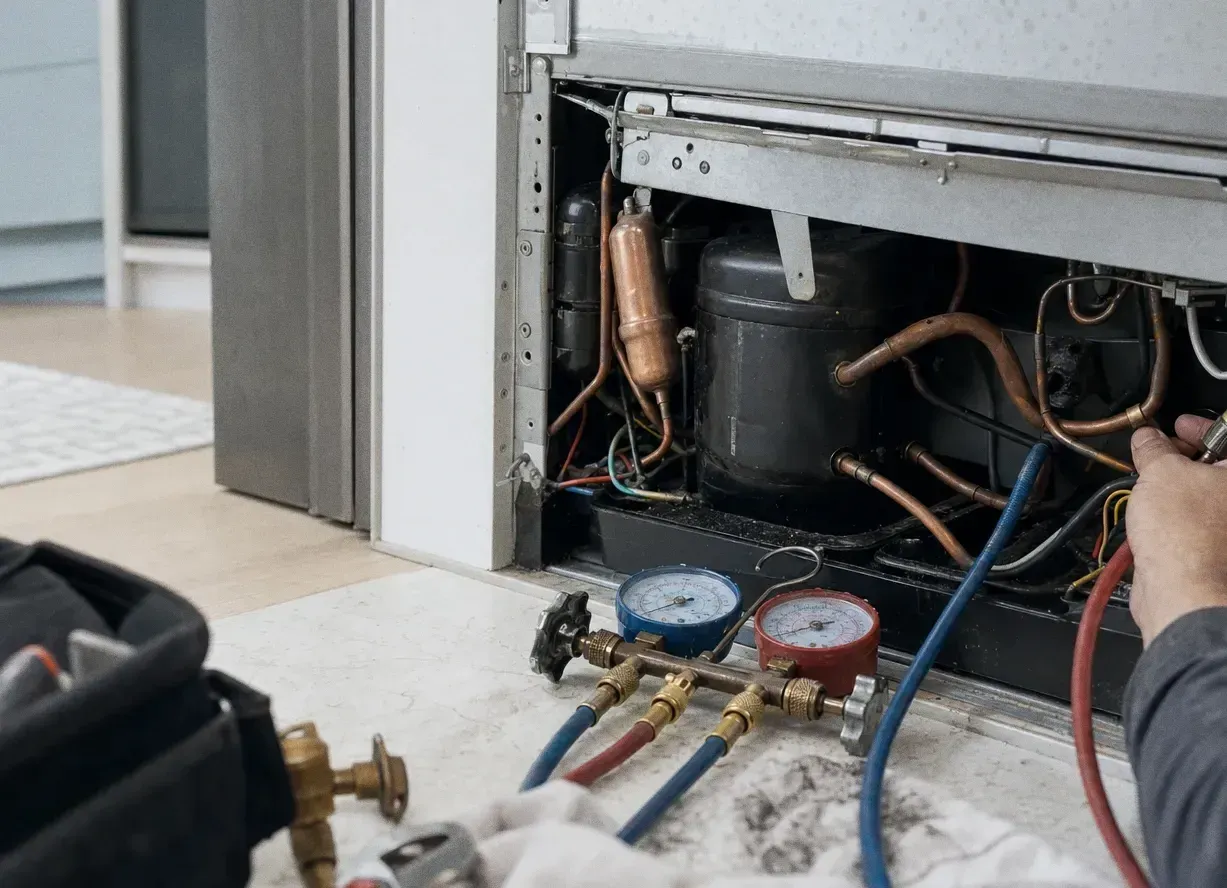
There is a lot of advice about refrigerator maintenance and most of it does not survive contact with a built-in. Sub-Zero units do not need their coils “conditioned”, their seals “treated”, or their electronics “reset” on a schedule. What they need is two things, and both are free.
One: clear the condenser
This is the single highest-value thing an owner can do, and the majority of the units we open have never had it done.
The condenser on a Sub-Zero built-in sits behind the grille at the top of the cabinet. Its job is to reject heat, and it does that by moving air across a set of fins. Fill those fins with dust and the appliance cannot get rid of its own heat, so the compressor runs longer to achieve the same temperature, and it runs longer every hour of every day for years.
That is what kills built-ins early. Not a dramatic failure — a slow, continuous overwork that nobody notices until the fresh food side starts drifting.
The job is straightforward: switch the unit off, remove the grille, and clear the fins with a vacuum brush attachment and a soft brush, working in the direction of the fins rather than across them. Ten minutes, twice a year.
On the coast this is not optional. In Gloucester, Rockport, Marblehead and anywhere within a mile of the water, salt in the air accelerates corrosion on the coil itself. A condenser that would give twenty-five years inland will not, and the units we see fail earliest are almost always coastal units where the grille has never come off.
Two: watch the door seal
A gasket is a wear part with no moving components, which is why people forget it exists. It hardens gradually, loses its grip at the hinge corner first, and long before you can see a gap the compressor is compensating for a slow leak of warm air.
Test it with a sheet of paper. Close the door on the paper and pull. It should offer real resistance. Do that at four or five points around the door, and pay particular attention to the top hinge corner, which is where every gasket goes first.
If the paper slides out easily at any point, the seal is finished at that point, and the whole gasket is the replacement rather than a section of it.
What is not worth doing
- Adjusting the temperature dial to compensate. If a compartment is drifting warm, turning the setting colder masks the symptom and increases the runtime that is already the problem. Find out why it is drifting.
- Defrosting a frost-free unit manually. If ice is building up, the defrost circuit has failed and clearing the ice by hand simply buys a few weeks before it returns.
- Cleaning the interior with anything aggressive. Warm water and a little dish soap. Solvents attack the liner and the gasket, and the gasket is the thing you were trying to protect.
What to watch for between services
Three signals worth acting on early, because each is cheap now and expensive later:
- A fan you can hear from the next room. Bearings give warning before they fail. Catching one costs a fan; missing it costs a fan and a warm compartment.
- One half warm, the other perfect. On a built-in with two sealed systems this is good news — it rules out the compressor and points at one evaporator, its fan and its defrost circuit.
- Water under the crisper drawers. A blocked drain channel, and clearing it is a small job. Left alone it becomes ice at the back wall and then an airflow problem.
The honest bit about age
A twenty-year-old Sub-Zero built-in is usually worth repairing, and by a wide margin. Replacement for a full-size unit runs well into five figures before panels and installation, and the components that fail at that age — fans, heaters, thermistors, gaskets — are a small fraction of it.
The exception is a sealed-system failure on a cabinet that already has other problems. We will say so when that is the situation, rather than quoting a compressor into a unit that will not repay it.
Also asked
How often should the condenser be cleared?
Twice a year is a sensible default and once a year is enough in a clean, inland kitchen. Two situations justify more: a household with shedding pets, and a coastal position where salt air accelerates everything. If you have never done it and the appliance is over ten years old, do it now and then set an interval afterwards.
Does a Sub-Zero need the vacuum panels replaced?
No, and nobody should be selling you that. The vacuum insulation panels are not a service item. If insulation performance has genuinely degraded that is an end-of-life conversation about the cabinet, not a maintenance task, and it is rare enough that we would want to rule out everything else first.
Is it worth replacing gaskets before they fail?
Only if they are already failing the paper test. A gasket that still grips is doing its job and swapping it early buys nothing. A gasket that has hardened at the hinge corner is costing you compressor runtime every hour of every day, and that one is worth doing before it becomes a temperature complaint.
Related
- Miele Dishwasher Maintenance: The Filter Nobody Has Lifted Most Miele dishwasher calls are not faults. They are years of maintenance that was never done, arriving disguised as a pump problem — and the part that fixes it is already in the machine.
- Ice Maker Not Working: What the Bin Is Telling You Empty bin, hollow shells, cloudy centres or one fused lump — each points somewhere different. Work out which of the four you have before anyone opens the appliance, because the fix for one has nothing to do with the fix for another.
- Thermador or Wolf: What the Difference Looks Like From Under the Range Both build serious cooking equipment and both are repairable for decades. Where they differ is in what fails, how often, and what it costs to put right — which is a more useful comparison than a specification sheet.
If it turns out to be the appliance
The $95 service call covers the visit and the full diagnosis, and it comes off the repair once you approve it. Engineers are out 8:00 am – 8:00 pm, seven days; the line is answered 24/7.