Dishwasher Repair
Miele Dishwasher Maintenance: The Filter Nobody Has Lifted
Most Miele dishwasher calls are not faults. They are years of maintenance that was never done, arriving disguised as a pump problem — and the part that fixes it is already in the machine.
3 min read Declan Moriarty, Refrigeration technician — sealed systems and airflow · 21 years in the trade
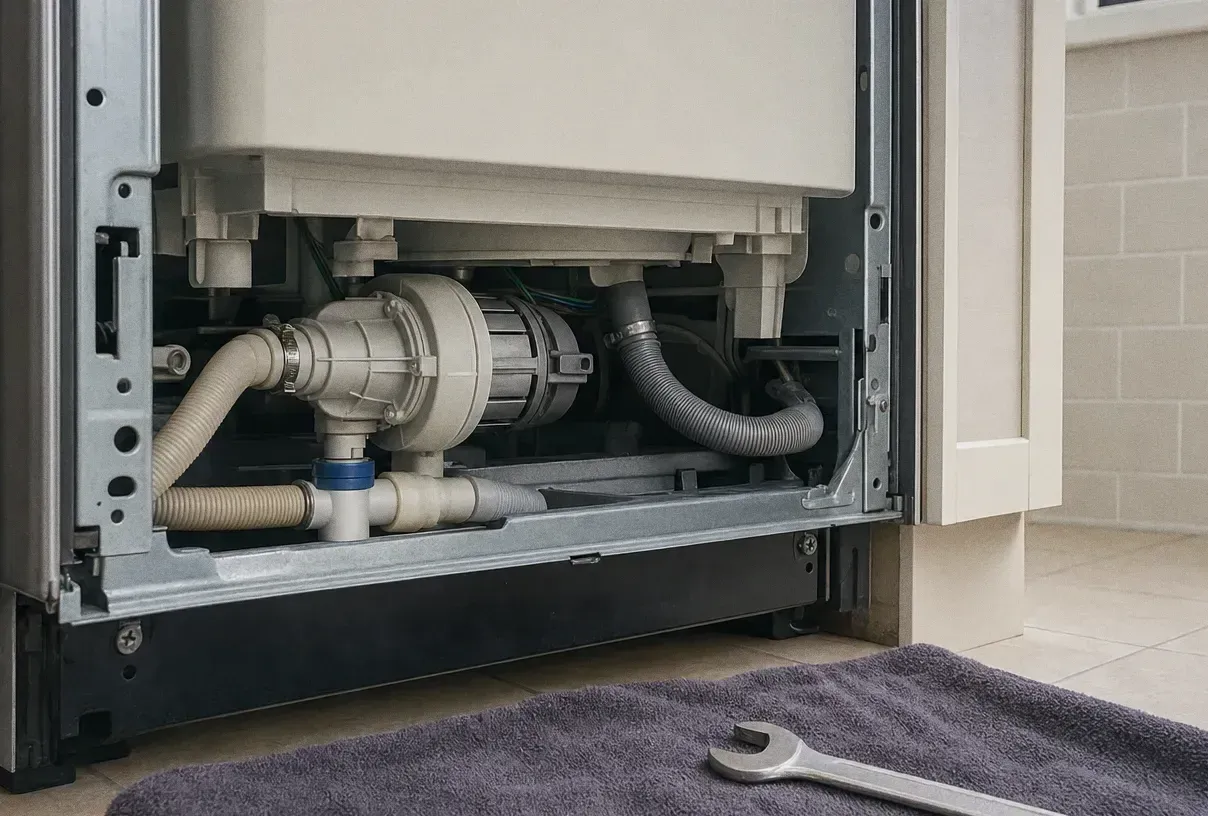
Miele builds dishwashers to a service interval rather than to a failure point, which is a real engineering distinction and it changes what goes wrong with them. These machines rarely break. They gradually stop working properly because something routine was never done, and then they present with a symptom that looks like a broken part.
The filter is the centre of it.
The filter you may not know exists
Under the lower spray arm there is a coarse screen, and under that screen sits a finer filter assembly that lifts out with a quarter turn. A great many owners have never lifted it. The machine does not complain, it does not throw a code, and it will keep running for years on a filter that is half blocked.
What happens instead is that wash quality declines so slowly nobody can say when it started. Glasses come out gritty. Something on the top rack is not getting clean. The natural conclusion is that the spray arm is blocked or the pump is weakening, and neither is true — the machine is recirculating water it cannot properly clear.
Lift it out, rinse it under a tap, brush the mesh gently, put it back. That is the whole job, and on a machine that has never had it done the difference in the next cycle is obvious.
Spray arms, while you are in there
Both arms come off without tools. Hold each one up to a light and look through the jets. Anything blocked clears with a toothpick or a straightened paperclip.
Nothing harder than that goes near a spray jet. A drill bit or a needle file will widen the hole permanently, and a widened jet sprays at the wrong pressure in the wrong direction for the rest of the machine’s life. It cannot be undone.
The wet-dishes question, settled
This is the most common Miele complaint we are called about and it is not a fault.
These machines use condenser drying: the load’s own residual heat evaporates the water, which condenses on the cool stainless tub wall and drains away. There is no heating element blasting the load dry. It is quieter, it uses less energy, and it is gentler on plastics — and it leaves plastics damp, because plastic holds very little heat of its own.
If dishes are coming out wet and they always have, the machine is working correctly. Open the door for ten minutes at the end of the cycle and the residual warmth finishes the job. If dishes used to come out dry and now do not, that is different, and worth a look.
What actually fails
Setting maintenance aside, three things genuinely break on these:
- The drain hose kinked behind the machine. Almost always the result of the appliance being pushed back too hard during a kitchen job. It presents as a drainage fault and is a plumbing one.
- The waterproof system tripping. Water in the base tray triggers a float, which shuts off the supply. The protection has done its job; what needs finding is where the water came from.
- The door seal, eventually. Decades in, and usually announced by a damp patch at one lower corner rather than by anything dramatic.
A rinse-aid note
Miele machines assume rinse aid is present and their drying performance is built around it. A machine running dry of rinse aid will leave spots on glass and more water on everything, which reads as a decline in performance. It is worth checking the reservoir before concluding anything about the machine.
When it is worth calling us
If wash quality has not recovered after the filter and the spray arms have been cleaned properly. If the waterproof system has tripped. If the machine will not start with the door plainly shut, which is usually the door latch microswitch rather than anything expensive. And if it drains partially — that pattern points somewhere specific and it is worth reading the code alongside the state of the sump rather than guessing.
Also asked
How often should the filter come out?
Monthly is the manufacturer's line and it is about right for a machine run daily. Every couple of months is fine for lighter use. The interval matters less than the habit — a filter lifted twice a year is enormously better than one that has never come out at all, which is what we usually find.
Why are my dishes wet at the end of the cycle?
Because that is how the machine dries. Condenser drying uses the residual heat of the load against a cool stainless tub rather than a heating element, so plastics in particular come out damp. It is a design characteristic, not a fault, and no repair will change it. Opening the door for ten minutes at the end does more than anything we could sell you.
The machine says it has a waterproof fault. Is that serious?
It means the system has detected water where water should not be and has shut off the supply to protect the house — so the protection worked. It is not something to reset and ignore. There is water in the base tray for a reason and finding the reason is the job.
Related
- Sub-Zero Maintenance: The Two Things That Actually Extend the Life of a Built-In Most of what gets sold as refrigerator maintenance changes nothing. Two things genuinely do — clearing the condenser and watching the door seal — and on the Boston coast the first of them is the difference between fifteen years and twenty-five.
- Ice Maker Not Working: What the Bin Is Telling You Empty bin, hollow shells, cloudy centres or one fused lump — each points somewhere different. Work out which of the four you have before anyone opens the appliance, because the fix for one has nothing to do with the fix for another.
- Thermador or Wolf: What the Difference Looks Like From Under the Range Both build serious cooking equipment and both are repairable for decades. Where they differ is in what fails, how often, and what it costs to put right — which is a more useful comparison than a specification sheet.
If it turns out to be the appliance
The $95 service call covers the visit and the full diagnosis, and it comes off the repair once you approve it. Engineers are out 8:00 am – 8:00 pm, seven days; the line is answered 24/7.