Ice Maker Repair
Ice Maker Not Working: What the Bin Is Telling You
Empty bin, hollow shells, cloudy centres or one fused lump — each points somewhere different. Work out which of the four you have before anyone opens the appliance, because the fix for one has nothing to do with the fix for another.
3 min read Declan Moriarty, Refrigeration technician — sealed systems and airflow · 21 years in the trade
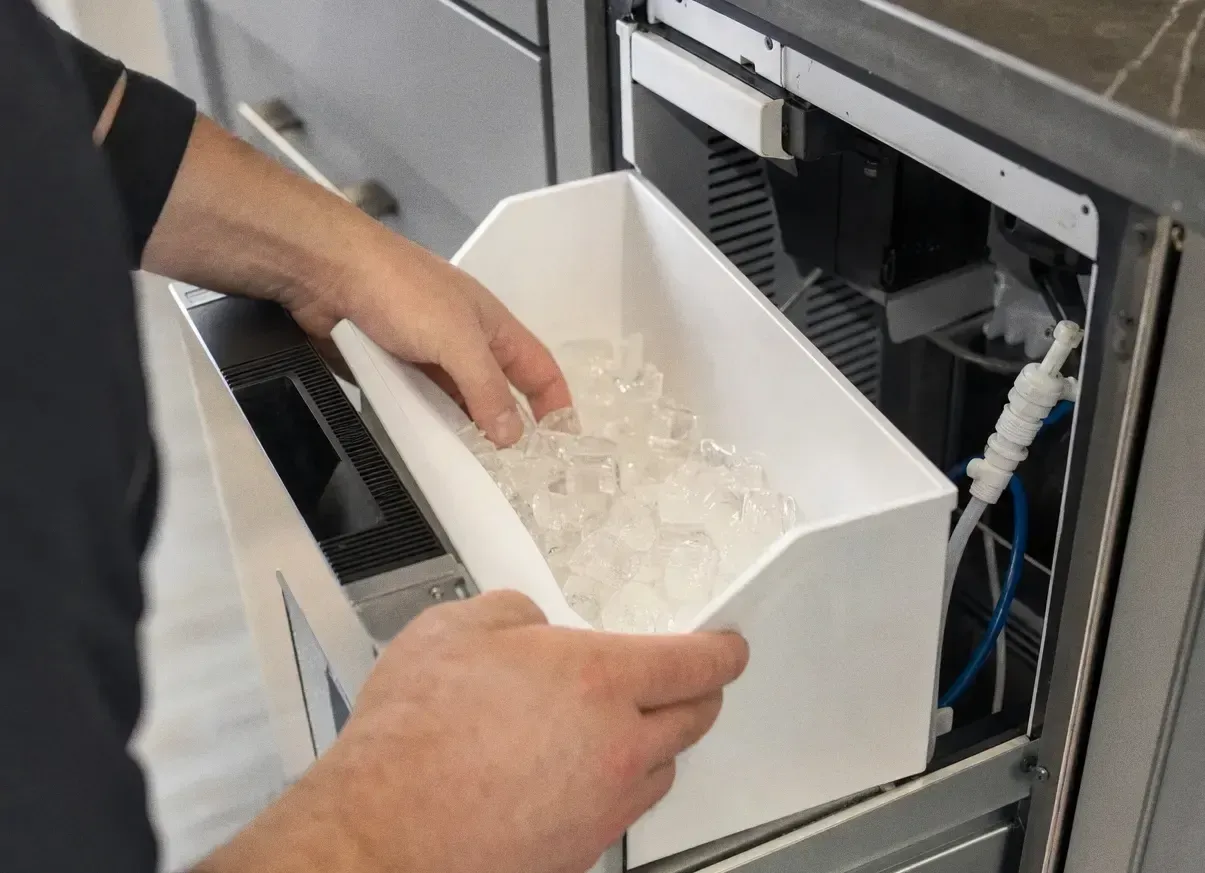
An ice maker is the only part of a refrigerator that hands you a physical sample of what has gone wrong. Everything else you have to infer. Here you can pick the evidence up and look at it, and four different bins point in four different directions.
So before anything is unscrewed: look at what is actually in there.
Four bins, four answers
An empty bin. Nothing has been made at all. That is water not arriving, or the compartment not getting cold enough to run a cycle, or the arm sitting in the off position because somebody knocked it. Check the arm first — it costs nothing and it is the answer more often than anyone admits.
Hollow shells. Cubes with dished sides that collapse when you pick them up. The mould filled short of what the cycle expected. That is a supply problem: a partly closed valve, a kinked line behind the unit, or a filter cartridge restricting flow.
Cloudy centres. Clear at the edges, white in the middle. This is not mechanical at all. It is dissolved air and minerals being driven ahead of the freezing front and left in the centre because they have nowhere else to go. Water quality, not hardware.
One fused lump. Cubes made correctly and then welded together. Either the bin turns over too slowly and everything sat there long enough to bond, or harvest is happening at the wrong point in the cycle.
When cubes form and never drop
This is worth separating out because it is the most misdiagnosed of the lot. If you can see perfectly formed cubes sitting in the mould and nothing is landing in the bin, the freezing side is working exactly as designed. What has failed is the release.
Release depends on warming the mould just enough to break the grip, then a mechanism sweeping the cubes clear. So the candidates are the mould heater and the harvest mechanism — not the water valve, which has already done its job, and not the cooling, which has plainly done its job too.
People replace inlet valves over this symptom regularly. It is the wrong part.
What is safe to do yourself
Two things, and they are worth doing before you call anyone:
- Empty the bin completely. A bin nobody empties explains slow production, fused lumps and stale-tasting ice all at once. Start from empty and give it a full day.
- Look behind the unit for a kinked supply line. On undercounter and built-in units that have been pushed back into a cabinet, this is common and entirely fixable with your hands.
And two things not to do. Do not lever a stuck cube out with a knife or anything else metal — the mould is soft enough to damage and a damaged mould never releases cleanly again. And do not hold the arm down to force a cycle.
Where the appliance is installed matters
More than owners expect, particularly for undercounter and island units. An ice maker built into an enclosed cabinet run with no ventilation path is being asked to reject heat into a sealed box. It will make ice slowly, or make it cloudy, or run constantly trying.
No part replacement fixes that. Sometimes the honest answer to an ice complaint is a vent rather than a component, and it is cheaper than anything else on the list.
When to call
If the bin is empty and the arm is in the right position and the compartment is properly cold. If cubes form and never release. If production halved without anything changing in the house. Or if you have a unit that has stood unused through a winter — houses that get shut up seasonally come back with lines that have been holding still water for months, and that needs flushing rather than diagnosing.
Also asked
How long should a bin take to fill from empty?
Longer than most people expect. A built-in ice maker producing a full bin in twenty-four hours is behaving normally; many take closer to a day and a half. If yours has always been slow, that is probably its rate rather than a fault. If it has become slow, that is worth a look.
Does the water filter really affect ice?
It affects flow rate, and flow rate is the specification the fill cycle depends on. A cartridge that physically fits but restricts flow will give you short, dished cubes even though nothing inside the appliance has failed. If cube quality changed within weeks of a cheaper cartridge going in, put a factory-approved one back before assuming anything worse.
The ice tastes of the fridge. Is that a fault?
It is usually absorption rather than breakage. Ice picks up whatever is volatile in the compartment, and a bin that turns over slowly has more time to do it. Empty it, discard the batch, and see whether fresh ice made over a couple of days tastes clean. If it still does not, the filter is the next place to look.
Related
- Wine Storage Temperature: What the Numbers Should Be, and Why Yours Drift A wine cabinet fails quietly. It does not alarm, it does not smell, and a five degree drift can run for weeks before anyone notices — which is why the reading matters more on this appliance than on any other in the kitchen.
- Wolf Range Troubleshooting: The Order That Actually Resolves It A Wolf burner that sparks and never lights is rarely the igniter. Check gas, then spark, then the fouled cap shorting the spark somewhere useless — and treat the oven cavity as a separate machine from the cooktop above it.
- Sub-Zero Maintenance: The Two Things That Actually Extend the Life of a Built-In Most of what gets sold as refrigerator maintenance changes nothing. Two things genuinely do — clearing the condenser and watching the door seal — and on the Boston coast the first of them is the difference between fifteen years and twenty-five.
If it turns out to be the appliance
The $95 service call covers the visit and the full diagnosis, and it comes off the repair once you approve it. Engineers are out 8:00 am – 8:00 pm, seven days; the line is answered 24/7.