Wine Cooler Repair
Wine Storage Temperature: What the Numbers Should Be, and Why Yours Drift
A wine cabinet fails quietly. It does not alarm, it does not smell, and a five degree drift can run for weeks before anyone notices — which is why the reading matters more on this appliance than on any other in the kitchen.
3 min read Declan Moriarty, Refrigeration technician — sealed systems and airflow · 21 years in the trade
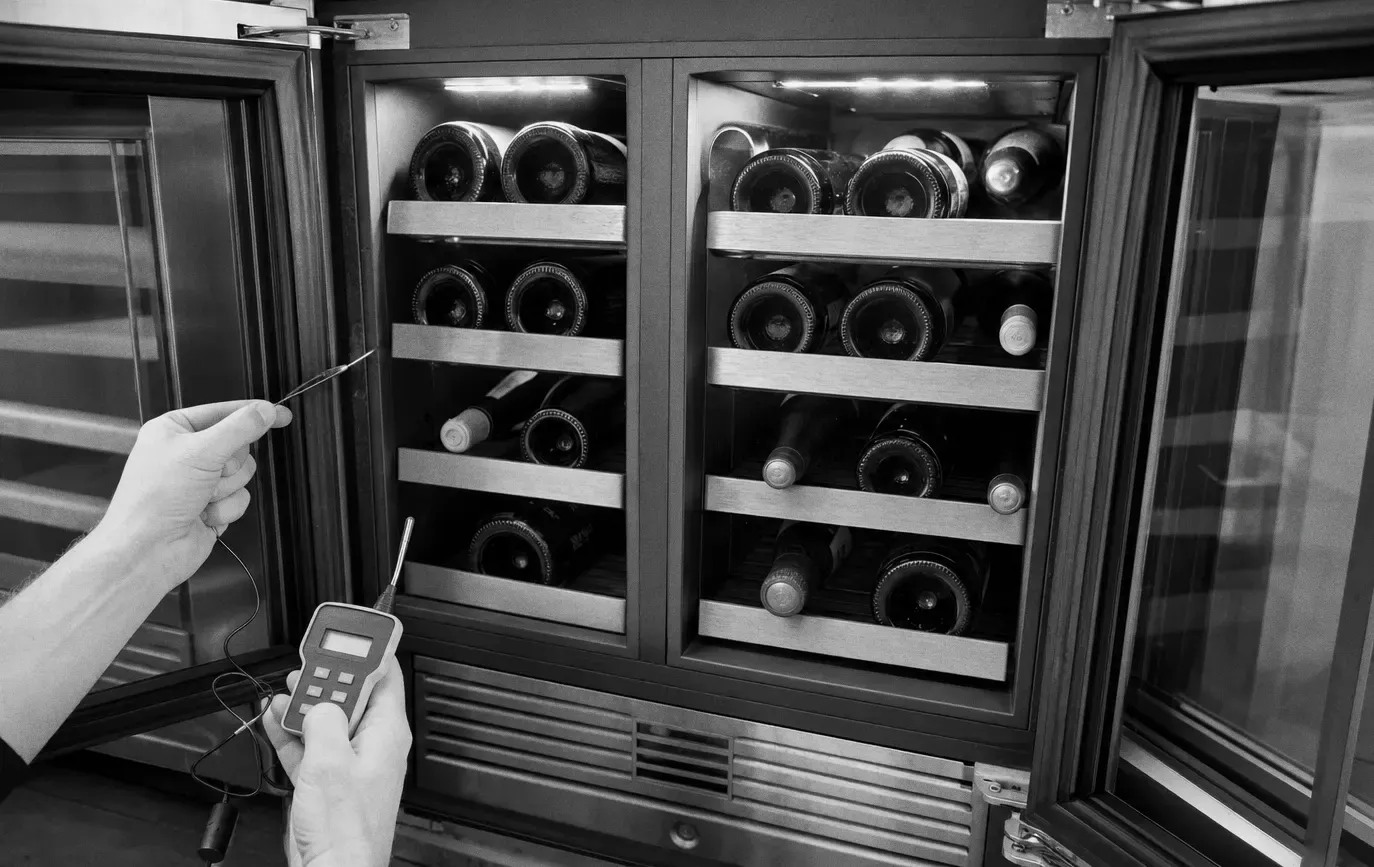
Every other appliance in the kitchen tells you when it has a problem. A refrigerator drifting warm produces milk that turns early. A freezer failing produces soft ice cream. A wine cabinet drifting five degrees produces nothing at all — no smell, no alarm, no visible change — and the damage it does is cumulative and invisible until a bottle is opened months later.
That asymmetry is the whole reason this appliance deserves an occasional look.
The numbers
- Long-term storage: 55°F is the cellar standard and a defensible setting for everything.
- Reds for serving: 60–65°F.
- Whites and sparkling for serving: 45–50°F.
- Humidity: 50–70%, which most cabinets manage without intervention.
The single most important number, though, is not any of those. It is stability. A cabinet holding a rock-steady 58 is doing a better job than one averaging 55 while swinging six degrees either side of it across a week. Wine responds to cycling — expansion and contraction working at the cork — more than it responds to being a few degrees off ideal.
Read the cabinet, not the display
Put an independent thermometer inside and leave it for a day. Then compare.
This is worth doing on any wine cabinet over about eight years old, and it is the check that catches the quiet drift. Control sensors go out of calibration gradually, and a display reading 55 while the cabinet sits at 61 is a common and entirely undramatic failure. Nothing about the appliance’s behaviour will tell you.
Dual zones that have converged
The most frequent wine cabinet call we take. Two zones, both settled at the same temperature, and no way of knowing how long it has been like that.
The usual causes are a damper that has stuck, so the cold air is no longer being apportioned between the compartments, or a sensor reporting from the wrong place. Both are ordinary repairs. Neither is the cooling system, which is why a cabinet in this state is still perfectly cold and gives no other sign of trouble.
Condensation on the glass
Humid air meeting a cold surface. Two candidates:
The seal. Test it with a sheet of paper the same way you would test a refrigerator door — close the door on it, pull, and expect resistance. Glass doors are heavier than they look, and a door closer that has weakened over the years will leave the door resting shut without actually sealing.
The room. Basement bars are the recurring case. A cabinet specified for a kitchen and installed in a damp basement is being asked to work against a humidity load it was not designed for, and the glass is where that shows.
Where it sits matters as much as what it is
Wine cabinets end up in the worst positions in the house: enclosed islands, cabinet runs beside dishwashers that vent into the same cavity, bars with no clearance behind them. All three make the appliance work harder than it should, and all three present as performance faults that no part will fix.
If a cabinet has always struggled, look at the installation before looking inside it. If it has recently started struggling, look inside.
Signals worth acting on
- Compressor running noticeably more than it used to.
- Both zones converged on a dual-zone unit.
- Condensation appearing inside the glass where it never did before.
- Display and thermometer disagreeing by more than two or three degrees.
- Any noise from a cabinet that has been silent — these are built to be quiet, so a new sound is genuinely out of character rather than something to live with.
Also asked
Is 55 degrees really the right number?
It is the standard cellar figure and a sound default for long-term storage of almost anything. What matters more than hitting exactly 55 is holding whatever number you choose. Wine tolerates a steady 58 far better than it tolerates a cabinet swinging between 52 and 62 across a week.
Both my zones read the same. Is that a fault?
On a dual-zone cabinet, yes. Two zones exist so they can be set apart, and when they converge the usual causes are a stuck damper or a sensor reporting the wrong compartment. It is a repair, and it is not an expensive one — but it will not fix itself.
There is condensation inside the glass door. What causes it?
Humid air reaching a cold surface, which means either the door seal is no longer sealing or the cabinet is in a position with more humidity than it was specified for. Basement bars are the classic case. Check the seal first; if it grips properly, the room is the variable rather than the appliance.
Related
- Ice Maker Not Working: What the Bin Is Telling You Empty bin, hollow shells, cloudy centres or one fused lump — each points somewhere different. Work out which of the four you have before anyone opens the appliance, because the fix for one has nothing to do with the fix for another.
- Wolf Range Troubleshooting: The Order That Actually Resolves It A Wolf burner that sparks and never lights is rarely the igniter. Check gas, then spark, then the fouled cap shorting the spark somewhere useless — and treat the oven cavity as a separate machine from the cooktop above it.
- Sub-Zero Maintenance: The Two Things That Actually Extend the Life of a Built-In Most of what gets sold as refrigerator maintenance changes nothing. Two things genuinely do — clearing the condenser and watching the door seal — and on the Boston coast the first of them is the difference between fifteen years and twenty-five.
If it turns out to be the appliance
The $95 service call covers the visit and the full diagnosis, and it comes off the repair once you approve it. Engineers are out 8:00 am – 8:00 pm, seven days; the line is answered 24/7.